A gigabyte of flash storage costs a fraction of what it did a decade ago. And yet a doctor’s visit, a year of college, or a night in the hospital costs more than ever. There’s a name for this pattern, and it has been around since 1966.
In that year, economist William Baumol and his collaborator William Bowen published a study of the performing arts that contained a deceptively simple insight. A Mozart string quartet takes four musicians about 40 minutes to perform — the same as it did in 1791. There is no way to speed it up without ruining it. No technology can make the violinists more “productive” in any meaningful sense. But those musicians still need to eat, pay rent, and compete for wages against workers in industries that do get more productive over time. So their wages rise — because the economy around them is doing more, not because they’re doing more. The cost of live performance rises relentlessly, from a structural feature of what it is, not from waste or inefficiency.
“The productivity of the quartet musician has not risen appreciably. But the real cost of a performance has increased substantially — and this is not a result of managerial failure or laziness.”
— William Baumol & William Bowen, 1966
Baumol generalized this into what became known as cost disease: in any economy with a productive sector (manufacturing, technology) and a stagnant sector (healthcare, education, government services, the arts), wages tend to equalize across both. Workers in the stagnant sector see rising wages because they must compete with the dynamic sector — but since their productivity doesn’t rise to match, costs in the stagnant sector grow without bound, relative to everything else.
The data fit the theory
Across most developed economies, the pattern Baumol identified has played out with fidelity. The price of physical goods — TVs, clothing, cars — has fallen or stayed flat in real terms. The price of services that require sustained human attention has climbed.
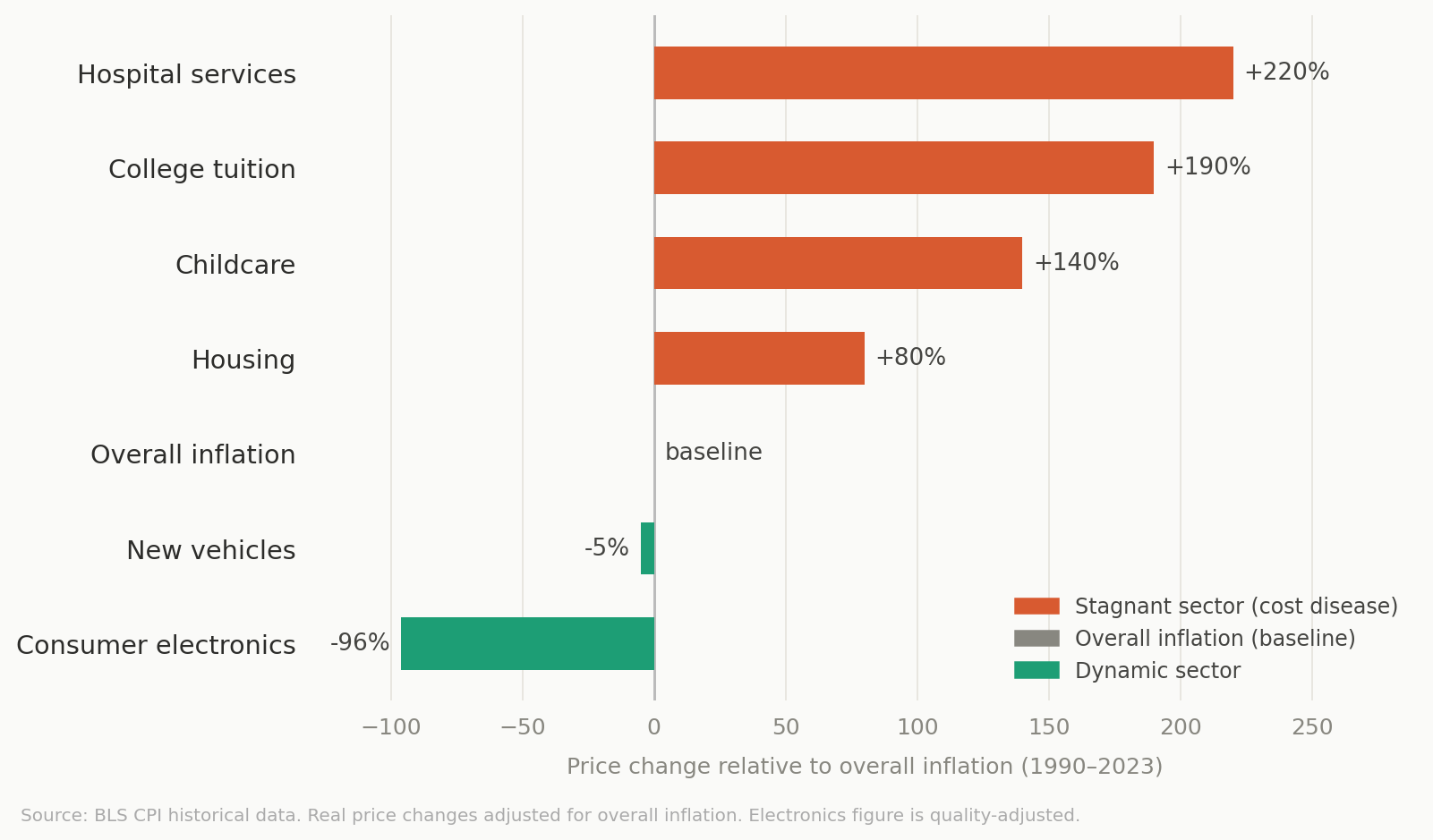
The wage side of Baumol’s prediction has also held. He argued workers in stagnant sectors would see rising wages — not because productivity justified it, but because labor markets force convergence. That’s what happened. Real wages for registered nurses, hospital workers, and healthcare support staff grew substantially over the past three decades, outpacing many manufacturing occupations. The musicians are paid more. The quartet still takes 40 minutes.
Where it gets complicated
The theory has critics, and some of the complications are real. Baumol assumed sectors like healthcare were fundamentally immune to productivity improvement. But endoscopic surgery replaced open surgery. Electronic health records (eventually) reduced paperwork. Telemedicine lets a physician see more patients per day. The stagnancy assumption is softer than he implied.
There’s also a measurement problem. A doctor’s visit in 2024 is genuinely different from one in 1990 — better diagnostics, better drugs, higher survival rates for cancers that were then death sentences. Standard price indices struggle to capture quality improvements, which means some of the apparent “cost increase” in healthcare is really a reflection of a better product.
And in the U.S. specifically, healthcare costs exceed those of comparable countries by a margin that Baumol’s mechanism can’t explain on its own. Cost disease tells you why healthcare is expensive everywhere. It doesn’t explain why American healthcare costs about twice what French healthcare costs for similar outcomes. That residual requires a different theory — market power, administrative bloat, billing complexity, insurance structure.
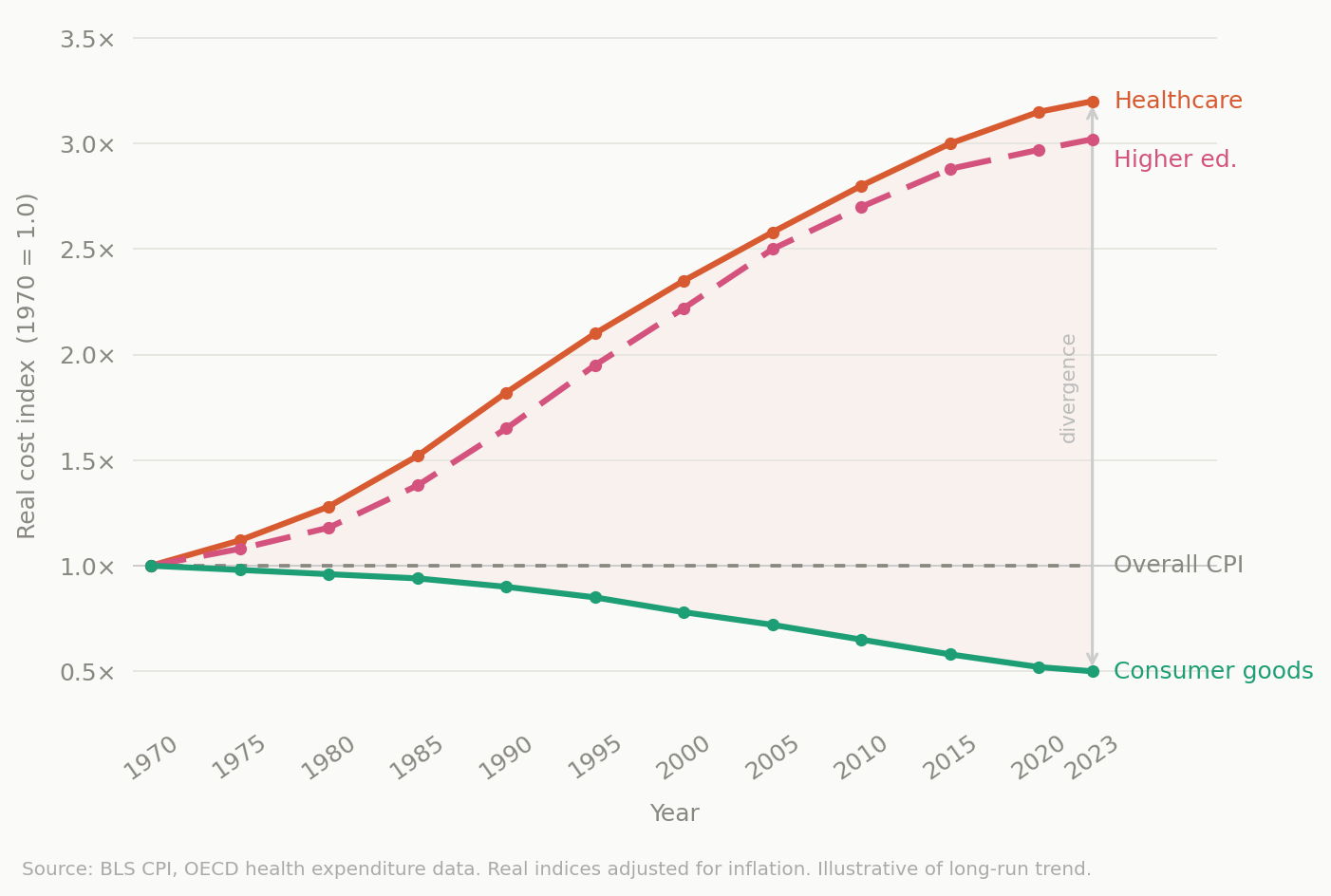
So was Baumol right?
Mostly. The structural observation — that productivity divergence between sectors, combined with wage equalization, creates persistent cost pressure in human-intensive services — is as close to an empirical law as economics produces. The data fits. The mechanism is clear.
What he underestimated was the partial permeability of the stagnant sector to productivity improvement, and — especially in the U.S. — the degree to which market failures and institutional dysfunction amplify cost disease into something considerably worse.
Data: BLS Consumer Price Index; BEA national accounts; OECD health expenditure statistics. Wage data from BLS Occupational Employment and Wage Statistics. Price change figures are approximate and inflation-adjusted. Charts illustrative of long-run trend.



Leave a Reply